2026/07/18
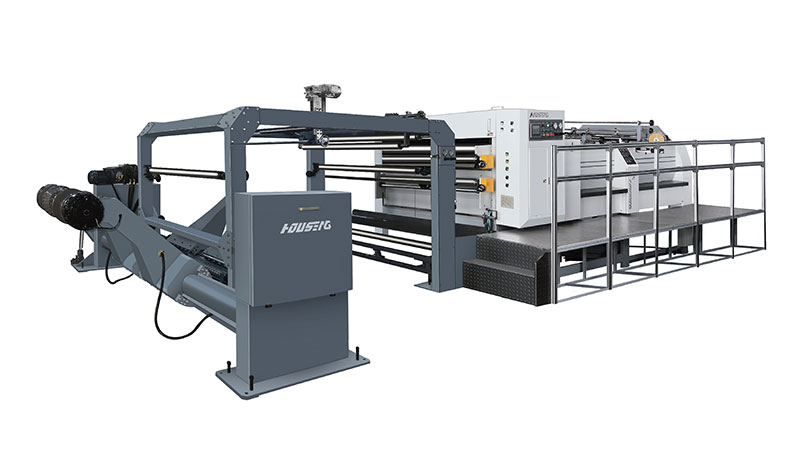
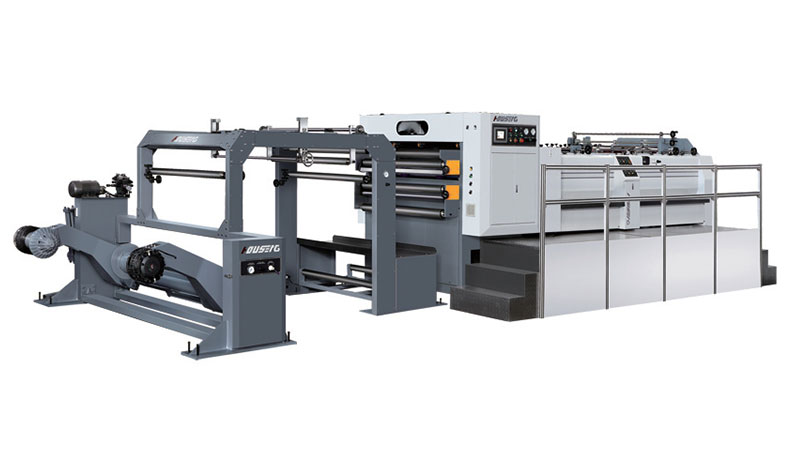
Selecting sheeting equipment for a paper converting line involves weighing multiple technical factors—knife design, frame construction, drive system configuration, and material compatibility. A servo driven single spiral sheeter occupies a distinct position in the converting equipment landscape: it uses a helical blade mounted on a rotating drum driven by a servo motor, cutting progressively across the web. This configuration offers a balance of speed, accuracy, and operational simplicity. Understanding which specifications matter for your specific application prevents both overspending on unnecessary capabilities and underspending on features critical to your output quality.
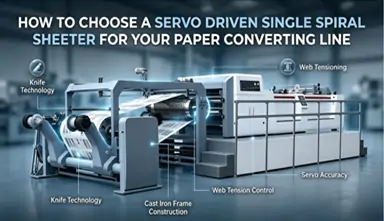
Knife Technology: The Cut Quality Starts Here
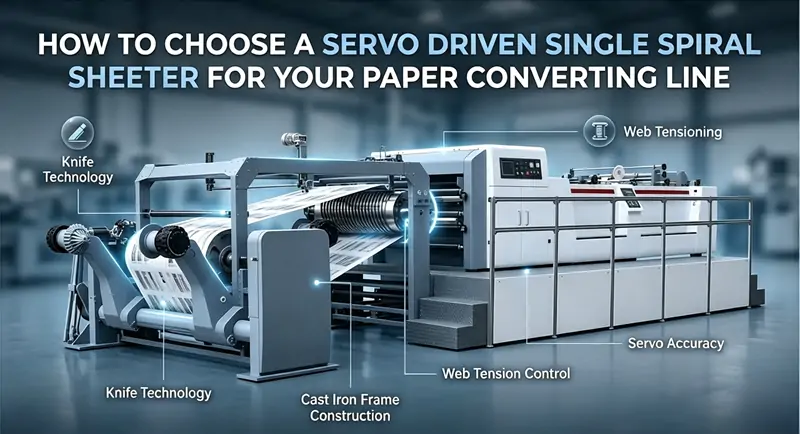
The knife drum is the core cutting component in a single-spiral configuration. Unlike a straight-knife guillotine action that chops across the entire width simultaneously, a helical (spiral) knife cuts progressively—the blade contacts the paper at one edge and slices across the sheet. This progressive cutting action distributes the cutting force over time, which reduces peak loads on the drive system and bearings.
When comparing machines, several knife-related specifications warrant close attention:
Knife material and heat treatment. High-grade alloy tool steel with proper hardening retains a sharp edge through extended production runs. The hardness specification of the knife material directly correlates with the interval between sharpenings and the total number of regrinds possible before the knife reaches its minimum usable diameter.
Bed knife construction. The lower knife seat—the stationary surface the spiral knife cuts against—requires high rigidity. Machines using cast iron for the bed knife holder, integrally formed and precision-machined, maintain the critical knife-to-bed clearance more consistently than fabricated assemblies that may micro-deflect under repeated impact loading.
Dynamic balancing. A spiral knife drum rotating at production speed generates rotational forces. If the drum has not been dynamically balanced after machining, residual imbalance transmits vibration through the frame, gradually degrading cut edge quality and accelerating bearing wear. Manufacturers typically specify the balancing standard applied to each knife drum.
These knife-related factors define the cutting performance of single-knife sheeting equipment and carry more weight in a thorough evaluation than headline speed figures alone.
Frame Material and Its Effect on Long-Term Precision
Frame construction affects cutting precision over the machine's service life. Each cut generates a shock that travels through the knife drum, bearings, and frame. A fabricated steel frame assembled from multiple pieces can develop stress concentrations at weld points. A cast iron frame produced as a single integrated casting absorbs vibration differently due to the inherent damping properties of nodular cast iron.
This matters for converters running multiple shifts or heavier grammages. Cast iron's vibration damping reduces resonance during high-speed operation, which helps maintain the knife-to-bed-knife clearance that determines edge quality. Cast iron also offers thermal stability—steel frames expand and contract with ambient temperature changes, which in unheated or poorly climate-controlled factory environments can subtly alter cutting geometry.
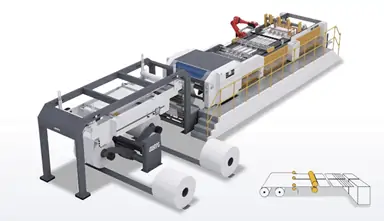
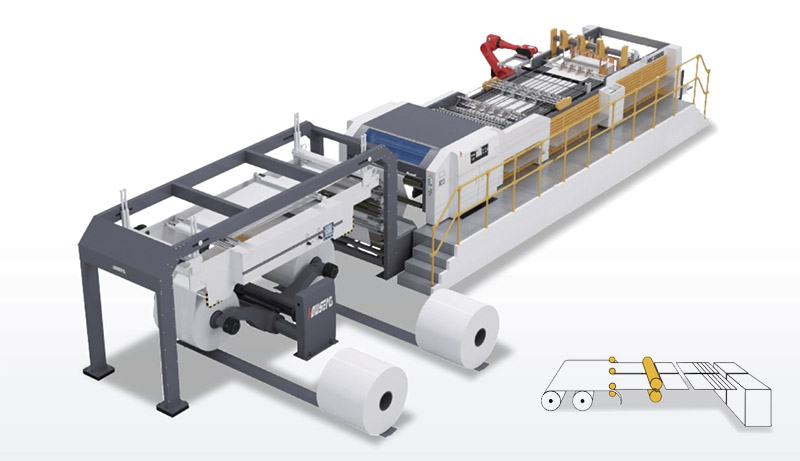
For production environments where the machine runs continuously across shifts, frame stability serves as the foundation supporting every other precision specification. Beyond the machine itself, how the equipment integrates into the broader converting workflow—from unwinding through final palletising—determines actual line efficiency. Many converters benefit from reviewing integrated sheeting line solutions that address the full material flow rather than evaluating the sheeter in isolation.
What Cutting Accuracy Specifications Actually Mean
The typical cutting accuracy specification for single-spiral machines—often stated as ±0.3mm—represents sheet length consistency under controlled conditions. Real-world accuracy depends on several interacting systems:
Web tension control. Variations in unwind tension directly affect sheet length. A machine with closed-loop tension control—where sensors monitor web tightness and adjust the unwind brake automatically—maintains length consistency better than one relying on manual adjustment. This matters particularly when running lightweight papers that stretch under excessive tension, or as roll diameter changes during unwinding.
Servo drive response. The servo motor controlling the knife drum and the servo driving the infeed must coordinate with minimal latency. Any delay between the measured web position and the knife position translates to sheet length variation. Equipment using established servo brands with proven motion controllers provides more predictable coordination between the feed and cut cycles.
Overlap section design. After cutting, sheets decelerate from line speed to stacking speed in the overlap section. If the speed transition is too abrupt, sheets scuff against each other or lose alignment. A properly designed overlap section with independently controlled fast and slow belts, synchronised to the knife speed, prevents these handling issues.
Matching the Grammage Range to Your Production Reality
Single-spiral sheeters typically advertise a grammage range of approximately 50 to 550gsm. This range describes what the machine can physically cut, not necessarily what it cuts efficiently for extended production. The practical operating window for continuous production often centres on the middle of this range.
For lightweight papers below approximately 80gsm, web handling becomes the limiting factor—the sheet can flutter, wrinkle, or stretch. For heavyweight board above approximately 350–400gsm, the knife experiences higher cutting loads, and maximum speed typically derates from the rated peak. A machine cutting 300gsm board at full rated speed may need to slow considerably for 500gsm material.
Key considerations for your material mix:
• If a significant portion of production involves heavyweight board, what speed derating applies?
• If coated papers are common, does the overlap section design prevent surface scuffing?
• If recycled or high-filler-content papers are typical, does the dust extraction system keep the knife area adequately clean?
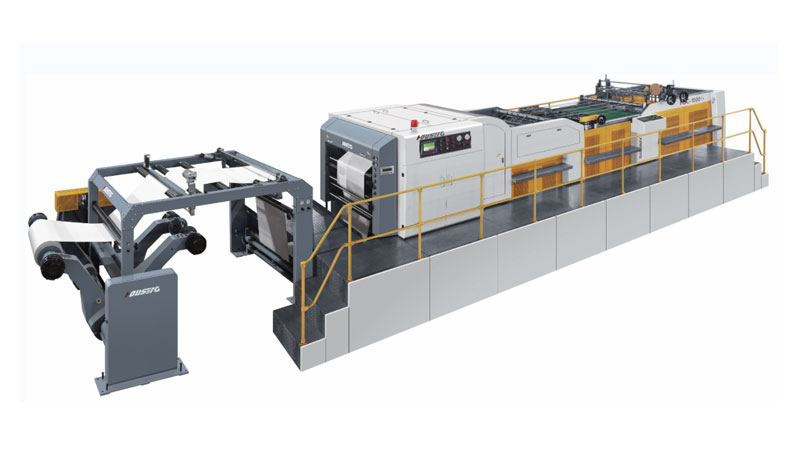
Clarifying which materials represent the majority of production volume ensures the selected machine operates in its efficient zone, not at the edge of its capability. For operations running diverse paper grades across shifts, servo driven sheeting equipment with cast iron construction provides the rigidity needed to maintain accuracy across the full material range.
From Specifications to Production Fit
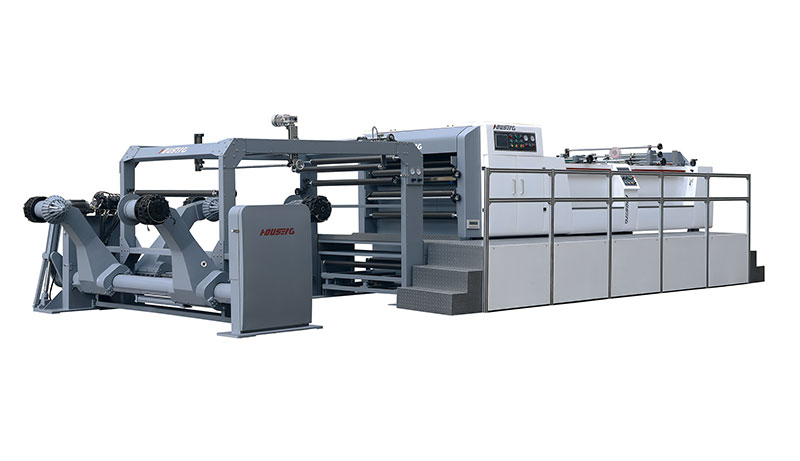
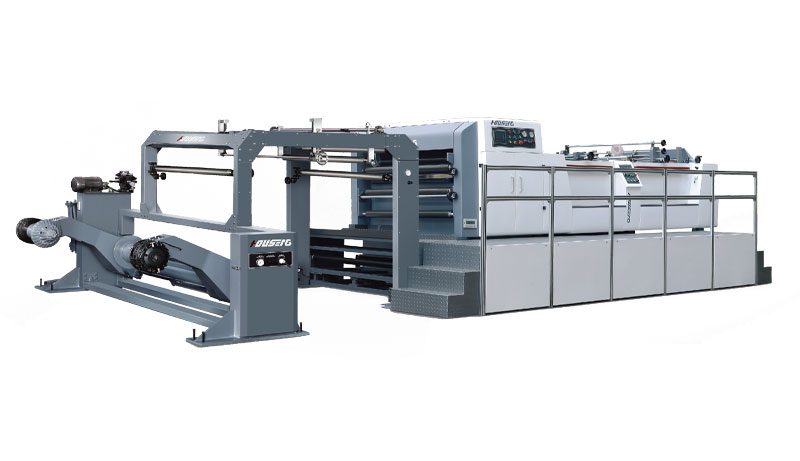
Specification sheets establish a baseline for comparison, but the actual fit between a sheeter and a production line depends on practical details: how the unwind stand accommodates typical roll diameters and core sizes, whether the slitting system adjusts efficiently for job changeovers, and how the delivery section presents stacked sheets for downstream handling. The machine with the highest headline numbers is not necessarily the best choice if its capabilities misalign with actual production requirements.
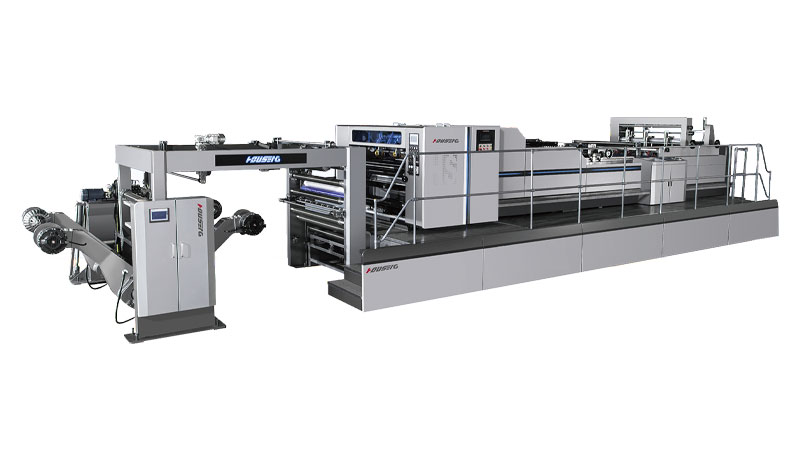
Evaluating how single spiral sheeting machine configurations address these practical factors—knife life, frame stability, tension control, and material range—provides a structured way to compare options against specific production needs. The objective is to identify equipment whose design characteristics match the work performed day to day, shift after shift.